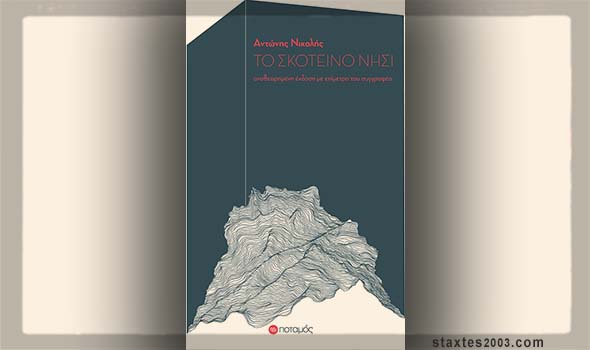
Silence and the Eclipse of Logos: Rupture, Residue, and Reconfiguration in The
Dark Island by Antonis Nikolís
Αντώνης Νικολής, Το Σκοτεινό Νησί ―εκδόσεις Ποταμός 2019
Introduction: Logos in Decline - Language at the Edge of Cultural
Extinction
The novella The Dark
Island by Antonis Nikolís, a work of considerable interpretive density and
distinctive formal coherence, situates itself among the most radical and
introspective contributions to contemporary Greek literature. It constructs a
narrative world in which the crisis of Logos is intrinsically bound to
the erosion of historical continuity, moral order, and subjective cohesion. The
work unfolds within a post-catastrophic environment marked by biopolitical
control, genetic segregation, and extreme isolation, where language no longer
functions as a stable medium of meaning-making but persists instead as the
residual trace of a cultural formation already undergoing advanced
decomposition. In this respect, the novella exceeds the conventions of
dystopian survival narrative and emerges as a sustained poetic meditation on
the conditions under which the human subject constitutes itself within
discourse and history.
The plot remains
outwardly austere. Within an isolated insular space, three figures coexist
temporarily, until the fragile equilibrium of their relations culminates in
rupture and murder. The significance of the work, however, resides less in the
sequence of external events than in the manner in which the narrative
orchestrates the corrosion of language, the dissolution of interpretive
certainty, and the exposure of the human body to regimes of control,
surveillance, and dependency. The tragic intensity of the novella arises
precisely from this displacement: from interpersonal conflict toward the more
fundamental failure of Logos to ground community, memory, and a stable
horizon of meaning.
The present study
approaches the novella along four principal axes. The first examines its
dramaturgical architecture; the second addresses narrative form and stylistic
differentiation; the third develops its central interpretive dimensions, with
emphasis on ontological, biopolitical, gendered, and ethico-philosophical
concerns; and the fourth situates the work within broader literary
constellations while assessing Nikolís’s distinctive expressive register. The
aim is to demonstrate that silence accumulates as a critical force within the
novella, while the eclipse of Logos registers the exhaustion of an
entire cultural paradigm.
I. Enclosed Worlds: Dramaturgy, Space, and the Politics of Survival
A World After History: Space, Time, and Residual Existence
The novella unfolds
within an almost deserted world shaped by contamination, environmental
collapse, and a regime of genetic classification dividing the “genetically
screened” from the “random,” accompanied by rhetoric of exclusion and
persecution. The principal setting is a cave and its surrounding terrain on a
small rocky islet - possibly the remnant of submerged land - named “The Dark
Island” by its elderly inhabitant, Horomedon, in reference to its humidity and
dense fog.
Into this space arrive a
young man and his companion, whom Horomedon renames Heracles and Bergamot
according to his own symbolic order. Their coexistence gradually produces a
triangular configuration charged with existential, ideological, and erotic tension.
The temporal horizon remains indeterminate yet oriented toward a future
governed by entropy and exhaustion. The absence of precise historical markers
reinforces the post-historical condition: the narrative unfolds in a world that
has already traversed catastrophe and now persists in a state of residual
duration.
The space itself
functions as a heterotopia of concentrated dramaturgical and symbolic
significance. The cave constitutes both the central locus of action and the
material field within which relations of survival and power are organized.
Humidity, fog, darkness, and inaccessibility generate an atmosphere of
suffocation, while the name “The Dark Island” condenses the convergence of
physical locality and internal condition.
At its core, the novella
stages the problem of coexistence within a closed system of limited resources.
Water, food, supplies, safety, and access define the material basis of
survival. Within this framework, an asymmetrical network of dependence, desire,
domination, and violence gradually emerges, transforming the cave into a
microcosm of biopolitical control, a disciplinary environment, and a stage upon
which life is continuously negotiated.
Tripartite Design: Symmetry, Perspective, and Dramatic Movement
The novella presents a
formally rigorous and semantically precise composition, organized into three
parts, each consisting of the successive personal narratives of the three
protagonists. Each figure recounts approximately the same events from a
distinct position of consciousness, desire, and power.
Part I establishes the
space, introduces the characters, and configures the initial relational
structure. Part II intensifies conflict and exposes the latent violence of
coexistence. Part III leads to the disintegration of Horomedon’s authority, the
decisive rupture, and the ambiguous departure of the surviving pair.
This tripartite
arrangement generates a clear dramaturgical trajectory: from the institution of
order to its gradual erosion, and from there to reversal and release. The
semantic center shifts accordingly. Initially, Logos operates as the
organizing force of space; subsequently, the violence embedded within it
becomes increasingly visible; finally, emphasis moves toward silence,
embodiment, and music, opening the possibility of another mode of relation.
Part I: Arrival, Naming, and the Establishment of Discursive Authority
Part I constitutes the
foundational scene of encounter. The arrival of Heracles and Bergamot in
Horomedon’s cave establishes a field of heightened observation in which every
gesture and utterance acquires amplified significance.
Heracles approaches the
space with caution and a desire for internal ordering. He perceives the cave as
a closed microcosm governed by Horomedon’s will. His inclination toward
calculation and organization reveals a consciousness seeking to inhabit the environment
through rational structuring.
Bergamot introduces a
qualitatively different presence. Her corporeality, tonal range, and movement
infuse the environment with sensory and verbal vitality, altering the
atmosphere from the outset. She introduces a rhythm of life that resists full
incorporation into rational control.
Horomedon establishes
himself as master of the space. His authority derives from his relation to the
environment, his control of resources, and his power to name and position
others. Naming assumes symbolic weight, marking the operation of power at the level
of discourse.
Part II: Escalation, Domination, and the Emergence of Ethical Tension
In Part II, tension
intensifies and the internal structure of coexistence becomes more sharply
articulated. Scarcity and enforced proximity remain decisive, while attention
shifts toward the formation of relations structured by power, fear, desire, and
guilt.
Heracles initially
adheres to calculation, attempting to render crisis intelligible and
manageable. Gradually, this stance loses adequacy. Exposure to violence,
transformations in his relation to Bergamot, and growing awareness of
Horomedon’s control lead him into a deeper ethical trial.
Bergamot undergoes the
full force of domination through humiliation and bodily constraint. Her voice,
however, retains steadiness, irony, and internal resilience. Her resistance
manifests through persistence and presence rather than through overt confrontation.
Horomedon emerges as a
figure of disciplinary sovereignty. His discourse seeks to define, classify,
and regulate, extending authority over bodies, affects, and interpretations.
His power assumes an implicit claim to totality.
Heracles’s perception
undergoes a corresponding shift, moving from hesitation toward ethical clarity.
This transformation forms the core of Part II and prepares the decisive
rupture.
Part III: Rupture, Violence, and the Opening of Exit
Part III constitutes the
space of culmination. Horomedon, having lost much of his physical and verbal
authority, appears diminished; his discourse becomes unstable, registering the
collapse of his dominance.
Bergamot assumes control
of the final movement. Through music, performance, irony, and timing, she
reshapes the conditions of the situation. Her mode of power operates through
rhythm, presence, and experiential modulation.
Heracles performs the
decisive act. The murder of Horomedon is rendered with physical intensity and
moral ambiguity, surrounded by guilt, confusion, and trauma. It resists
reduction to a single interpretive frame.
Following the act, the
tonal register shifts. Rain, the possibility of departure, the boat, and the
persistence of music establish a horizon of continuation. Survival remains
marked by memory and trauma, yet opens toward a quiet and tentative form of hope.
Dramaturgical Synthesis: From Discursive Control to Embodied Release
The dramaturgical
organization of The Dark Island constitutes one of its most compelling
achievements. The tripartite structure ensures a coherent development of
conflict, while the cave functions as a unified scenic core in which survival,
discourse, power, embodiment, and music converge. The movement from authority
to erosion, and from there to release, provides the work with both formal rigor
and interpretive openness.
II. Voices at the Limits: Polyphony, Authority, and the Fragmentation of
Meaning
Polyphony as Structure: Truth in Dispersion
The narrative form of The
Dark Island is grounded in a rigorously structured polyphony. The three
central voices correspond to the principal consciousnesses that shape the
unfolding action, each offering a distinct apprehension of a shared
experiential field. Every voice embodies a specific relation to experience,
memory, desire, and language. Within this configuration, truth emerges not as a
stable or unified given, but as the provisional outcome of a dynamic interplay
among partial and often competing perspectives.
This polyphony operates
structurally rather than cumulatively. The voices do not function as parallel
recountings of an already established sequence of events; instead, each
produces its own interpretive horizon and its own mode of access to what has
occurred. Heracles narrates under the pressure of reflective awareness and
doubt; Horomedon constructs a discourse of authority, classification, and
interpretive mastery; Bergamot articulates experience through performance,
irony, and rhythmic immediacy. Polyphony thus constitutes the primary site of
meaning production within the novella, shaping both its epistemological
orientation and its broader cultural logic.
At the same time, beneath
the apparent autonomy of the voices, a clearly discernible compositional
discipline governs the text. The sequencing of narrative segments, the
distribution of decisive episodes, and the controlled alternation of
perspectives reveal a high degree of structural intentionality. The work
maintains formal unity without diminishing the distinctiveness of its voices,
achieving a finely calibrated balance between coherence and plurality.
Narrative Reflexivity: Testimony, Perspective, and the Instability of
Authority
The recurrence of
analogous or overlapping events across different narrative perspectives confers
upon the novella a pronounced metanarrative dimension. The text places its own
conditions of articulation under sustained scrutiny. Questions concerning the
position of the speaking subject, the organization of memory, and the
mechanisms through which authority is claimed and maintained through language
become central to the interpretive process.
Each narrative section
operates as a form of situated testimony. Every voice illuminates certain
aspects of the shared field while obscuring others, inflecting experience
through its own psychological disposition and ideological orientation. The
resulting structure resists any straightforward consolidation into a single,
authoritative account. Instead, it requires an active process of
reconstruction, inviting the reader to assess the distances between accounts
and to apprehend the relational constitution of truth.
This reflexive dimension
is inseparable from the novella’s central concern. The crisis of Logos is not
confined to thematic representation; it is inscribed within the very
architecture of the narrative. Each voice demonstrates both the generative
capacity of language and its inherent limits, rendering discourse itself a
field of tension, instability, and gradual erosion.
Heracles: Reflection, Hesitation, and the Formation of Ethical
Consciousness
“As I undressed,
folding my suit…, he quietly raised his forehead and looked at me; I was unsure
whether his gaze was cold or warm… Yet I never asked him; perhaps I grasped his
stance from the outset.”
The style of Heracles is
marked by introspection, analytical precision, and a persistent awareness of
uncertainty. His discourse reveals an ongoing effort to impose order upon
experience and to secure internal coherence. His language tends toward clarification,
careful observation, and measured evaluation of both persons and situations.
“There are two things
we must economize: water and our feelings.”
This orientation reflects
a subject who seeks to stabilize his position through the linguistic
organization of the world. Language functions here as a medium of containment,
an instrument through which experience becomes intelligible and manageable.
At the same time, the
distinctiveness of Heracles’s voice lies in its inherent fragility. His
reflective mode is closely linked to delayed comprehension, emergent
self-awareness, and a sustained effort to situate himself within an unfolding
and increasingly destabilized environment. The narrative traces the gradual
transformation of a consciousness that moves from hesitation toward
responsibility. Through this stylistic trajectory, the novella articulates the
emergence of a subject capable of action only after prolonged internal
negotiation.
Horomedon: Discursive Sovereignty and the Internal Collapse of Authority
“thou who gleanest
stray rumours, woman, trifling rhetoraster, thou ruinous scribe
…”
Horomedon’s voice is
shaped by rhetorical density, tonal assertiveness, and a pronounced degree of
self-consciousness. His discourse assumes a declarative and classificatory
form, charged with moral judgment and structured by an insistence on authority.
His language presents itself, often with conspicuous display, as a vehicle of
cultural continuity and interpretive dominance. Elevated diction, archaizing
inflections, syntactic elaboration, and aphoristic gestures all contribute to
the projection of this authoritative stance.
At the same time, this
very style becomes a medium of exposure. The more forcefully Horomedon asserts
the stability and legitimacy of his verbal order, the more evident his
dependence upon it becomes. Gradually, his language itself undergoes a process
of disintegration. The form of his discourse registers, with striking
immediacy, the progressive exhaustion of the authority it seeks to sustain. In
this sense, language becomes the site in which power reveals its own fragility.
Bergamot: Performance, Rhythm, and the Reinscription of Experience
“I waited. I was
watching, and I waited. Besides, my love, we’re women…we know how to play the
long game.”
Bergamot’s voice
constitutes the most dynamic and embodied stylistic register within the
novella. Orality, ironic acuity, performative flexibility, abrupt tonal shifts,
and a constant interplay between language and physical presence define her mode
of expression. Her discourse does not merely recount events; it actively shapes
atmosphere, reorganizes relational dynamics, and imbues situations with a
distinctive theatrical energy.
The significance of
Bergamot’s voice lies in its capacity to generate an alternative experiential
field. Within her speech, irony, corporeal memory, playfulness, and rhythm
acquire interpretive force. Her presence enables a displacement away from the
regime of discursive sovereignty toward another form of relationality, one
grounded in sensory immediacy, performative enactment, and artistic expression.
Music Beyond Logos: Rhythm, Memory, and Shared Temporality
Music occupies a
structurally decisive position in The Dark Island. Bergamot’s songs,
vocal inflections, repetitions, and culminating gestures of movement constitute
a distinct mode of linguisticity in which sound, rhythm, and embodiment
converge. Music activates memory and engages the body, offering a form of
participation that unfolds within shared temporality. It emerges most
forcefully at the points where verbal authority begins to weaken.
Its significance becomes
especially pronounced toward the conclusion of the novella, where rhythm and
song accompany the movement toward departure:
“We were dancing. It
is the rhythm of an ancient Cuban bolero.”
Through this shift, part
of the semantic burden of the narrative is transferred to a mode of expression
grounded in vocal energy and embodied coexistence. Music appears as a residual
yet potent form of meaning, capable of sustaining relationality beyond the
disintegration of Logos.
III. Interpretive Horizons: Ontology, Power, and the Ethics of Survival
Theoretical Constellations: Interdisciplinary Approaches to a Polyphonic
Text
The
Dark Island
invites a layered and methodologically composite reading. Its formal
organization, the relations it stages, and the singular function assigned to
music call for the combined use of narratological, philosophical, biopolitical,
and aesthetic approaches. The polyphonic structure requires an interpretive
framework attentive to the relational constitution of truth. Heracles’s
trajectory opens a field of existential inquiry centered on responsibility and
action. The cave, as a site of regulation and control, lends itself to a
biopolitical reading. Music, finally, demands an aesthetic approach capable of
recognizing rhythm as a form of relation.
These levels operate in
continuous interaction. The dynamic of the novella emerges from their
interweaving. Narrative form, the organization of the body, the crisis of
verbal authority, and the emergence of song participate in a unified field of
meaning within which discourse and embodiment remain in sustained tension.
Ontological Configurations: Identity as Relation and Process
The novella poses, with
particular intensity, the question of identity. Its characters appear as
unstable configurations, exposed to the force and desire of the other. Heracles
constitutes himself as a consciousness seeking both internal coherence and ethical
orientation. Horomedon organizes his selfhood through language, naming, and the
mythologization of his own authority. Bergamot, by contrast, constructs her
presence performatively through rhythm, embodiment, mobility, and affective
intelligence.
The work advances an
understanding of identity as relational rather than substantial. Subjectivity
emerges as process, as a way of positioning oneself within the world and as
continuous exposure to forces that reshape it. The self is neither fixed nor given;
it is negotiated within a field structured by power, desire, and vulnerability.
Biopolitics and the Administration of Life
“The cave is mine,
this time is mine, their lives are mine now.”
The biopolitical
dimension of the novella is articulated with clarity and precision. Water,
food, bodily functions, hygiene, cleanliness, and spatial organization acquire
a distinctly political character. Life itself becomes subject to surveillance,
and everyday existence is structured as a disciplinary regime. The cave thus
operates as a microcosm of power exercised directly upon life.
Horomedon embodies this
logic. He defines, regulates, supervises, and extends his authority over
bodies, emotions, and interpretations. His rule penetrates beyond external
command and reaches into the intimate structures of existence.
“I monitor her natural
functions daily. Three meals, two urinations, one defecation. That is the
method: three-two-one. What matters is the consolidation of normality: rain or
shine, everything in its proper time.”
Heracles occupies an
intermediate position in which passivity, complicity, and ethical awakening
coexist. Through his evolving stance, the novella renders with precision the
manner in which life, once subjected to regimes of management, becomes an
object of domination. The political dimension thus unfolds as the concrete
administration of the living rather than as abstraction.
Psychoanalytic and Gendered Dynamics: Power, Desire, and Embodied Identity
The relation between
Horomedon and Heracles carries a pronounced psychic and symbolic charge. The
younger man functions as a bearer of continuity, of desired completeness, and
of a possibility of recognition that Horomedon seeks to appropriate through control
and discourse. The destabilization of this relation accompanies the collapse of
his authority.
Bergamot introduces a
fundamentally different configuration of gendered presence. Her femininity is
articulated through style, body, voice, and performance. It does not assume a
fixed identity but unfolds as a dynamic mode of being. Heracles embodies a vulnerable
and internally divided masculinity, marked by hesitation and ethical tension.
Horomedon represents a form of patriarchal masculinity grounded in discursive
authority and the claim to domination.
Gender, within the
novella, emerges as relation, expression, and embodied positioning within a
field of power. It appears not as an essential category but as a performative
and situational mode of existence.
Ethics Beyond History: Action, Responsibility, and Residual Time
The ethical intensity of
the novella is concentrated in the trajectory of Heracles. His final act does
not function as a simple restoration of order. It is inscribed as an act
bearing responsibility, marked by guilt and traumatic residue. Its significance
lies in the transformation it produces, as a consciousness defined by
hesitation becomes capable of decision and action.
“Horomedon […] lives
with the idea that his thoughts possess, or will come to possess, ‘historical
value’… This, I think, is Horomedon’s fever…”
The post-historical
dimension of the work emerges through the persistence of History as a primarily
linguistic residue within Horomedon’s discourse, while lived experience is
organized around survival, decay, and bodily proximity. Historical continuity no
longer structures meaning; it survives as an echo within language.
The future appears as an
open and indeterminate horizon rather than as a linear continuation of an
established order. What remains is a minimal temporality grounded in
continuation rather than teleology.
IV. Literary Resonances and Nikolís’s Style
Nikolís’s affinity with
Beckett, already evident in his later work The Gymnasium, is both
thematic and structural. The enclosed and desolate setting, the de-historicized
condition of the world, the crisis of voice, and the centrality of silence,
combined with an existential austerity marked by subdued dark humor, establish
a clear field of comparison. Consciousness in The Dark Island appears
exposed, frequently divided, and situated within an environment in which
language has relinquished its former authority and stability.
The figure of Horomedon
invites comparison with Bernhard, particularly in relation to rhetorical
excess, intellectualism as symptom, and the gradual stripping away of a voice
dependent upon its own assertion of authority. His insistence on verbal control
generates both psychological intensity and ideological tension while
simultaneously revealing its fragility.
The polyphonic structure,
the distribution of experience across distinct consciousnesses, and the
fragmentary construction of truth allow for a productive parallel with
Faulkner. Experience is mediated through partial perspectives and gains density
through their interaction. At the same time, the fluid interiority present in
all three voices suggests a selective affinity with Woolf, whose influence can
be discerned, in varying degrees, across Nikolís’s broader work.
On a broader comparative
axis, individual motifs and formal elements invite further intertextual
associations. The closed triangular coexistence recalls Sartre; the opaque
authority of space evokes Kafka; Bergamot’s ironic and performative voice
resonates with Bolaño; the micro-community under conditions of crisis recalls
Saramago; and the island as a site of altered temporality suggests Bioy
Casares.
Nikolís’s originality
resides in the synthesis of a distinctly personal linguistic economy. His
writing brings together corporeality, stylistic precision, orality,
philosophical density, and dramaturgical discipline. Each voice carries a
distinct texture and internal weight. In this way, the novella renders the
erosion of verbal authority both as thematic content and as a formal process.
Appendix A: Song, Memory, and the Reconstitution of Meaning
The Two Songs
The two songs performed
by Bergamot occupy a decisive position within the semantic structure of the
novella.
“The cool, the
sweat-drenched skin / we barely even tasted…”
“The Song of My
Great-Grandmother’s Tomato Plant” gathers memory, corporeality, sensory
immediacy, and a form of popular ritual resonance. It evokes intimacy with the
material world while preserving a collective and affective charge.
“The Coffee Song,” by
contrast, activates the sphere of everyday care, modest pleasure, and quiet
cohesion:
“Cup after cup of
coffee, have you ever counted how many? … / Life, foolish, sweet, bitter, a
warm sip…”
Taken together, the two
songs provide Bergamot with a mode of vocal presence that operates beyond the
framework of Horomedon’s discursive authority. Music assumes a distinctive
function, linking memory to rhythm and community to embodied experience. It establishes
an alternative structure of meaning grounded in participation rather than
control.
Appendix B: The Poetics of Departure and the Final Tonal Resolution
The Final Paragraph and the Horizon of Exit
“We moved forward bent
over, careful not to stumble on any rock. We were heading toward the remainder
of our lives. We were sinking into something like a joyful void. The future,
neither did we wish to foresee it, nor to influence it any longer. Let it be
exciting, and let it take us wherever the hell it pleased.”
The final paragraph
condenses with striking clarity the tonal resolution of the novella. The
departure of the two figures is rendered through images of bodily effort,
careful movement, and open exposure to what lies ahead. The experience of time
undergoes a decisive transformation. The impulse to master the future recedes,
giving way to a composed acceptance of indeterminacy.
The phrase “joyful void”
crystallizes this condition in a concentrated form. The work concludes in an
atmosphere of restrained openness, within which life persists beyond the burden
of the preceding regime of authority and control.
Conclusion: After Logos, Silence and the Minimal Persistence of Meaning
The
Dark Island
emerges as a novella of notable formal coherence and substantial philosophical
depth. Its dramaturgical discipline, polyphonic construction, stylistic
differentiation, and conceptual density converge in a narrative that examines
with precision the erosion of authority, the crisis of Logos, and the search
for a fragile form of shared existence.
Horomedon, Heracles, and
Bergamot articulate three distinct relations to the world. The first organizes
existence through discursive authority; the second traverses a path of internal
division toward action and responsibility; the third embodies rhythm, voice,
corporeality, and performance. The work gradually moves toward a space of exit
in which music, silence, and shared movement acquire central significance.
Its distinctiveness lies
in the composure and intensity with which it shapes this transition. Within the
exhaustion of a dominant cultural paradigm, it suggests the possibility of
withdrawal into a domain in which meaning persists in minimal yet resonant
form.
Excursus: Xenophon Revisited
From
Virtue to Art: Rewriting the Heracles Paradigm
Xenophon’s allegorical
narrative, as transmitted through Socrates in the Memorabilia (2.1.21 to
29), constitutes a foundational articulation of the moral paradigm in Greek
thought. Heracles, young and alone, encounters two female figures. Virtue
offers a life of hardship, discipline, and enduring glory. Vice promises
pleasure, ease, and immediate gratification. His choice in favor of Virtue
inaugurates a trajectory grounded in labor, restraint, and commitment to
lasting values.
The young man in The
Dark Island, while positioned at a comparable psychological threshold,
follows a markedly different path. His decision leads away from both vice, as
defined within the Socratic framework, and from traditional virtue. The murder
of Horomedon functions as a form of alternative catharsis and as a symbolic
severance from the paternal figure, enabling entry into Bergamot’s domain, a
field structured by rhythm, embodiment, affective memory, and performative
presence.
The protagonist thus
emerges as a reconfigured Heracles, a modern figure who, confronted with the
tension between Logos and music, turns toward the transformative force of art
rather than toward virtue understood as submission to a normative and patriarchal
order. Like an initiate into a Dionysian mode of existence, he continues his
trajectory within an altered existential horizon.
Within this
reconfiguration, the classical opposition between Virtue and Vice is
fundamentally displaced. Virtue appears as an exhausted ideological formation,
while Bergamot, as a figure of performance, music, and subversive vitality,
becomes the primary horizon of meaning. The inherited philosophical dilemma is
thereby reformulated. The eclipse of Logos marks the collapse of a broader
cultural architecture, while, in its aftermath, music and embodied presence
sustain a minimal yet enduring form of continuity.

